CASE STUDY · WEB APP · BUSINESS MANAGEMENT SOFTWARE
BMS — Business Management Software
A vertical business management system for a multi-location Freedom Mobile dealer with 12+ stores. It replaced spreadsheet-driven operations with one platform for sales, inventory, commissions, compliance, KPI reporting and targets, used by everyone from sales reps to the CEO.
- role · full-stack developer
- span · Nov 2024 – present
- stack · React · TypeScript · Node.js · MongoDB
- impact · manual commission work eliminated
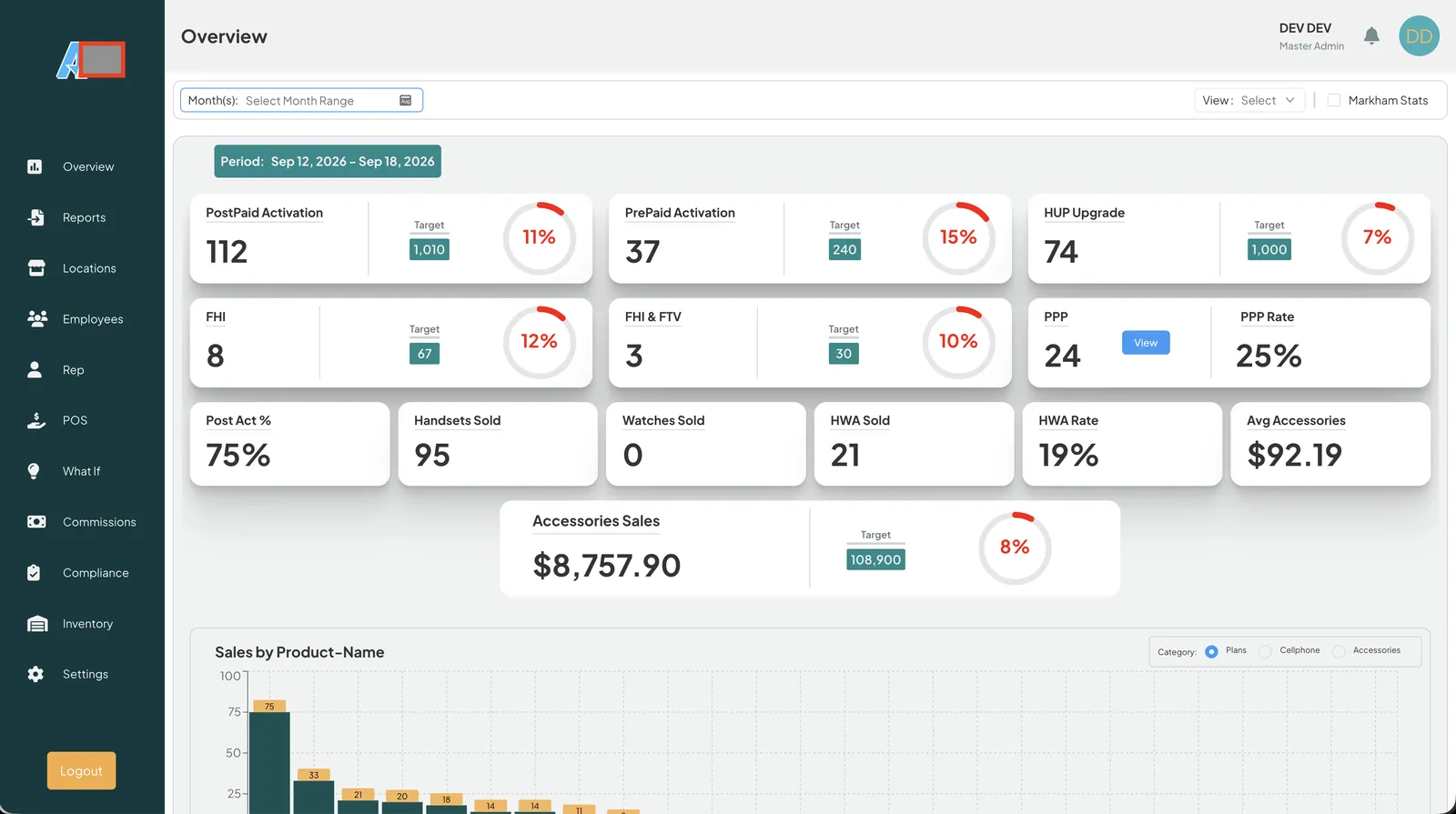
01 / 03Overview dashboard: the modules (Reports, Locations, Employees, POS, What If, Commissions, Compliance, Inventory, Settings) and live KPIs such as postpaid and prepaid activations, upgrades, home internet, protection plans and accessory sales against target.
DATA PIPELINE
- POS, carrier & inventory exportsseveral source systems
- ETL: normalise & validate100K+ records / day
- BMS databasesingle source of truth
- Dashboards & reportsstore · rep · company
COMMISSION ENGINE
- Quarterly rulesstructured JSON config
- Deterministic enginesales data × rules
- Validationtypes · ranges · consistency
- Human reviewreps · managers · CEO
- Payouttraceable to the rules
THE PROBLEM
The dealer ran on spreadsheets, with no reliable way to calculate sales-rep commissions.
- The carrier redefines its commission policy every quarter, and the dealer decides separately what it actually wants to pay its reps.
- Each payout combines metrics, thresholds, rates, bonuses and caps. By hand it was slow and error-prone.
- Errors meant disputes with reps and money leaking out of a thin-margin business, with no transparent way to show a rep why an amount was owed.
WHAT I BUILT
A full BMS made of independent modules that share one database:
- Commissions: dynamic quarterly rules, thresholds, base pay and product mappings.
- Compliance: rules, weighted scoring, monthly reports and pass/fail logic.
- Inventory: stock tracking, purchase orders, minimum levels and budgets.
- Reporting & targets: company, store and rep KPIs, monthly targets and quarter tracking.
- Access control: Master Admin, General Manager, Finance, Operations and Sales Rep roles.
HOW THE COMMISSION ENGINE WORKS
- Configuration is the source of truth. Each quarter’s rules are defined once as structured JSON and govern every payout.
- Deterministic calculation. Every figure breaks down into its metrics, thresholds, intermediate steps and amounts.
- Human review before payout. Reps, managers and leadership check the breakdown before any commission is paid.
CONTROLS FOR MONEY-CRITICAL CODE
- Validation: required metrics exist, inputs match expected types and ranges, and results agree with the configured rules.
- Auditability: quarterly rule changes and the calculations they produced are attributable and reviewable.
- Testing & CI: Jest and Postman for tests; Git and GitHub Actions for CI/CD.
HOW PEOPLE USE IT
Three non-technical groups: sales reps check and query their own commissions, location managers and admins review payouts across stores, and the CEO signs off. I gathered requirements with them directly and provided training and hands-on support, so the tool was adopted rather than just delivered.
IMPACT
- The manual commission process was eliminated entirely, along with hand-calculation errors and the disputes they caused.
- Reps get transparent, reviewable payouts for the first time.
- Spreadsheets were replaced by one source of truth used across departments.
- The wider BMS helped enable a stronger sales year (+35% in 2025), alongside the many factors beyond software that drive sales.